Milk-Bone Soft & Chewy Mini#s Graveyard Bones, Halloween Dog Treats, Beef & Filet Mignon Flavor
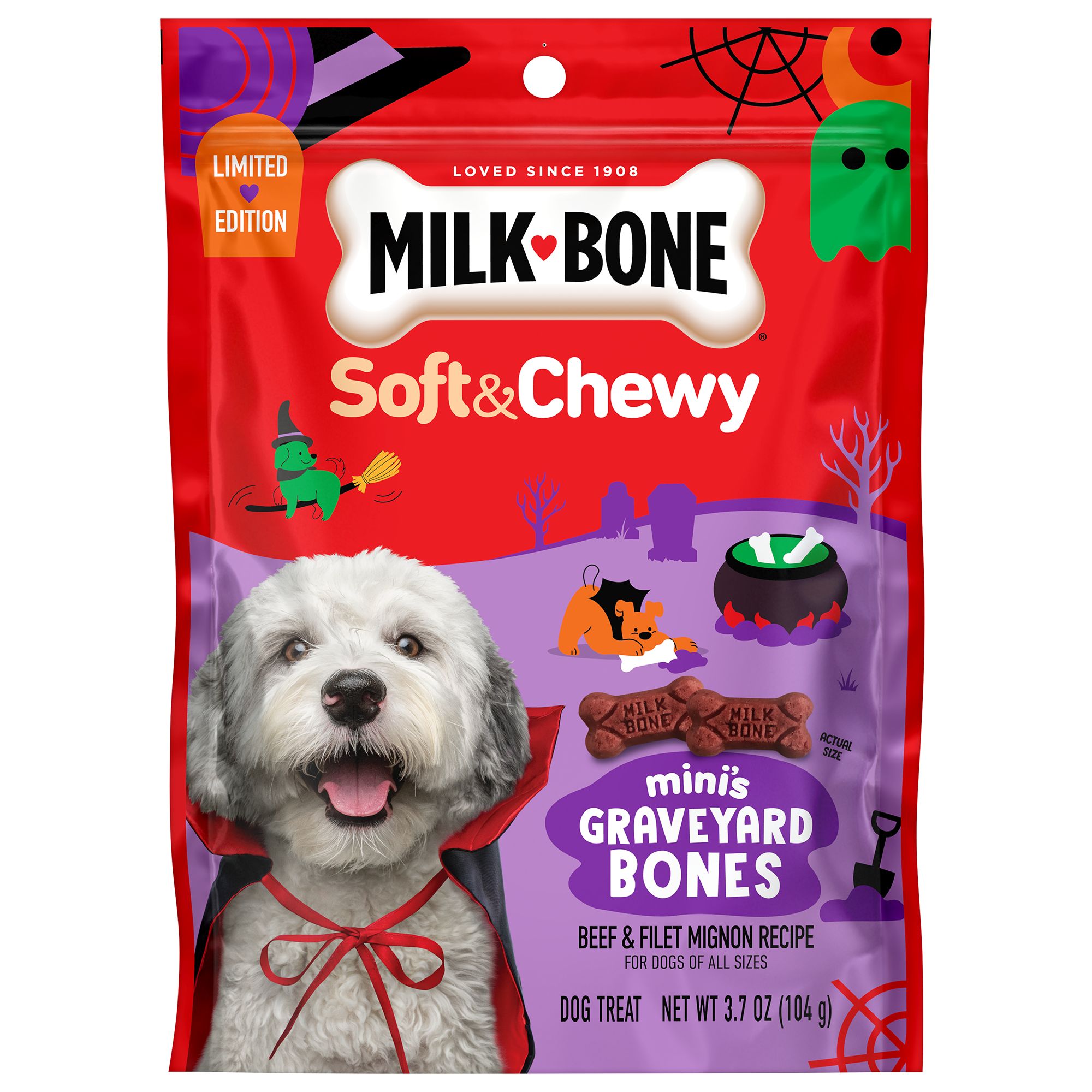
by Milk-Bone
Overall Score: 78/100
Ingredients
- Beef (protein)
- Chicken (protein)
- Soy Grits (other)
- Sugar (other)
- Corn Starch (other)
- Dicalcium Phosphate (mineral)
- Rice Flour (other)
- Salt (mineral)
- Natural Smoke Flavor (other)
- Propylene Glycol (additive)
- Guar Gum (additive)
- Garlic Powder (other)
- Lactic Acid (other)
- Potassium Sorbate (Used As A Preservative) (other)
- Vitamins (Vitamin E Supplement, Niacin Supplement, Vitamin A Supplement, D-Calcium Pantothenate, Riboflavin Supplement, Pyridoxine Hydrochloride, Thiamine Mononitrate, Vitamin D3 Supplement, Folic Acid, Biotin, Vitamin B12 Supplement) (other)
- Minerals (Ferrous Sulfate, Zinc Oxide, Manganous Oxide, Copper Sulfate, Calcium Iodate, Sodium Selenite) (other)
- Red 40 (additive)
- Yellow 5 (additive)
- Bha (Used As A Preservative) (other)
- Blue 2 (additive)
Ingredient concerns
- Propylene Glycol (high concern): The FDA has banned propylene glycol from use in cat food because it causes Heinz body formation in feline red blood cells, leading to anemia. It is still permitted in dog food. While 'generally recognized as safe' (GRAS) for dogs and humans at approved levels, its presence in pet food is increasingly viewed negatively by consumers due to its industrial applications (antifreeze component, though less toxic than ethylene glycol). Some pets may experience gastrointestinal upset.
- Sodium Selenite (low concern): Sodium selenite is an inorganic form of selenium with a narrower safety margin than organic forms (such as selenium yeast). It has lower bioavailability and higher potential for toxicity at elevated levels compared to organic selenium sources. Some premium pet foods use selenium yeast instead as a safer alternative.
- Red 40 (high concern): Provides no nutritional benefit whatsoever and is added solely for the visual appeal to human buyers, as dogs and cats have limited color vision. Multiple studies have raised concerns about behavioral effects in children, leading the EU to require warning labels on foods containing Red 40. Some animal studies have suggested potential genotoxicity, though results are debated. The FDA maintains it is safe at approved levels, but many veterinary nutritionists recommend avoiding artificial colors entirely.
- Yellow 5 (high concern): Like Red 40, Yellow 5 provides no nutritional value and is added only for appearance. It has been associated with hypersensitivity reactions and behavioral effects in children in multiple studies. Banned or restricted in several countries. The EU requires warning labels on products containing tartrazine. No legitimate reason for its inclusion in pet food.
- BHA (high concern): Classified as a possible human carcinogen (Group 2B) by the International Agency for Research on Cancer (IARC). Animal studies have shown BHA can cause forestomach tumors in rodents. While the FDA still permits its use in pet food at controlled levels, many pet food manufacturers have voluntarily removed it in favor of natural preservatives like mixed tocopherols.
- Blue 2 (high concern): Another artificial color with zero nutritional value. Some studies have found associations with brain tumors in male rats at high doses, though these findings are not universally accepted. Like other artificial colors, it exists in pet food solely for marketing purposes and offers no benefit to the animal.
Guaranteed analysis (dry-matter basis)
On a dry-matter basis (water removed for a fair wet-vs-dry comparison): protein 23.1%, fat 10.3%, fiber 3.2%, ash 7.5%, carbohydrate 56%. By calories: 22.2% from protein, 24% from fat, 53.8% from carbohydrate.
Dry food, with grains.
Similar products
- Milk-Bone Dipped Toffee Flavored Dog Biscuits With Vanilla Yogurt Flavored Coating 10 oz — 84/100
- Milk-Bone All Life Stages Soft & Chewy Dog Training Treats Made With Real Filet Mignon - Beef 18 oz — 84/100
- Milkbone All Life Stages Soft & Chewy Beef Training Dog Treats - 4.5 oz — 84/100
- Milk-Bone Dipped Dog Treat All Ages - Peanut Butter — 83/100
- Milk-Bone Soft & Chewy All Life Stage Dog Treats - Chicken — 81/100
As an Amazon Associate, KibbleWatcher earns from qualifying purchases at no cost to you. Our scoring is independent of any affiliate revenue.