Milk-Bone Brushing Chews Mini Dog Dental Chews - Original
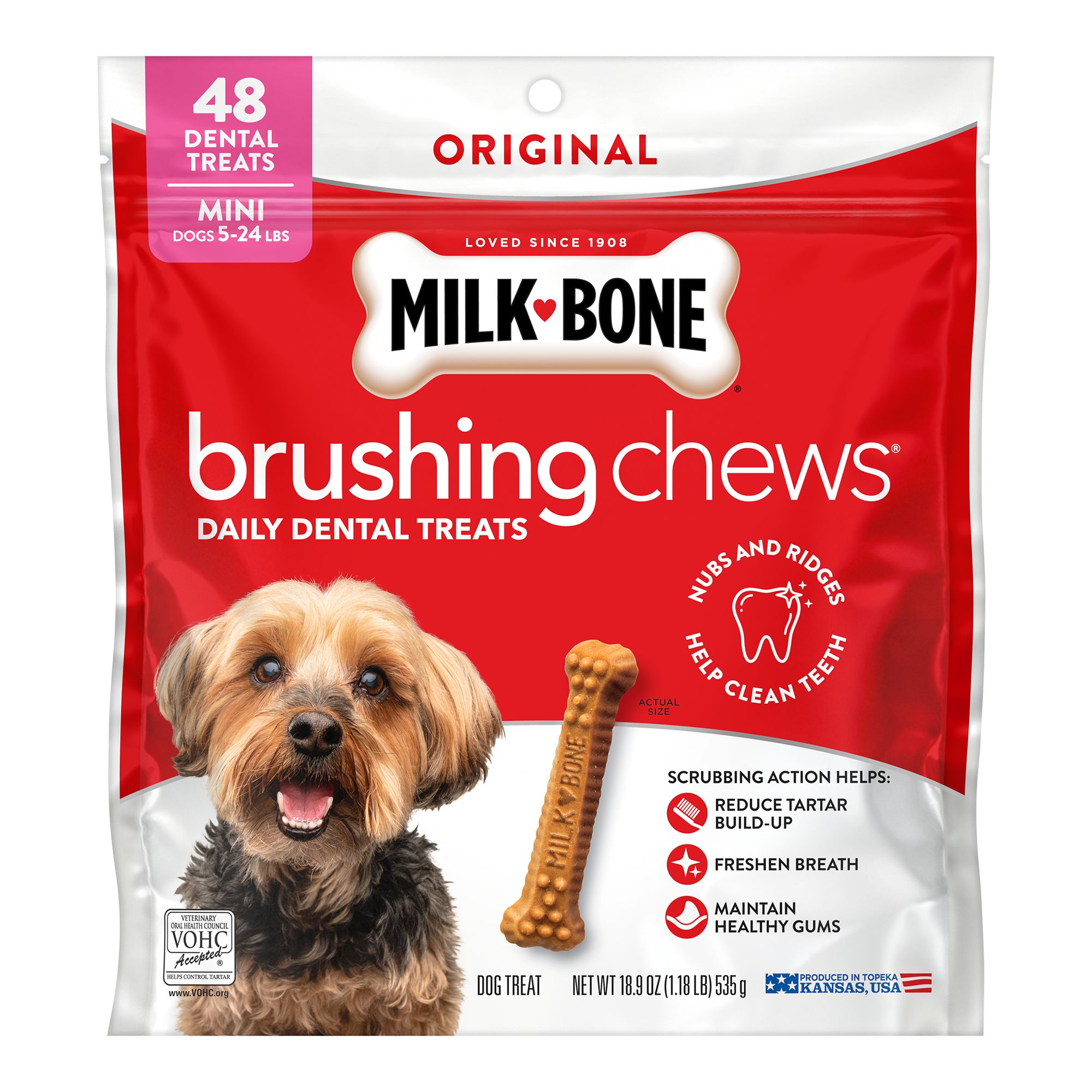
by Milk-Bone
Overall Score: 75/100
Ingredients
- Water (other)
- Sodium Tripolyphosphate (other)
- Bone Phosphate (other)
- Calcium Sulfate (other)
- Gelatin (other)
- Animal Digest (additive)
- Potassium Sorbate (used As A Preservative) (other)
- Phosphoric Acid (other)
- Titanium Dioxide (color) (other)
- Minerals (ferrous Sulfate, Zinc Oxide, Manganous Oxide, Copper Sulfate, Calcium Iodate, Sodium Selenite) (other)
- Vitamins (vitamin E Supplement, Niacin Supplement, Vitamin A Supplement, D-calcium Pantothenate, Riboflavin Supplement, Pyridoxine Hydrochloride, Thiamine Mononitrate, Vitamin D3 Supplement, Folic Acid, Biotin, Vitamin B12 Supplement) (other)
- Natural Smoke Flavor (other)
- Yellow 6 (other)
- Yellow 5 (additive)
- Bha (used As A Preservative) (other)
Ingredient concerns
- Animal Digest (high concern): Animal digest does not specify the source species, making it impossible to trace or verify quality. It is essentially a palatability enhancer made from chemically or enzymatically broken-down animal tissues of unspecified origin. Pets with food allergies cannot safely consume products with generic animal digest since the protein source is unknown.
- Sodium Selenite (low concern): Sodium selenite is an inorganic form of selenium with a narrower safety margin than organic forms (such as selenium yeast). It has lower bioavailability and higher potential for toxicity at elevated levels compared to organic selenium sources. Some premium pet foods use selenium yeast instead as a safer alternative.
- Yellow 5 (high concern): Like Red 40, Yellow 5 provides no nutritional value and is added only for appearance. It has been associated with hypersensitivity reactions and behavioral effects in children in multiple studies. Banned or restricted in several countries. The EU requires warning labels on products containing tartrazine. No legitimate reason for its inclusion in pet food.
- BHA (high concern): Classified as a possible human carcinogen (Group 2B) by the International Agency for Research on Cancer (IARC). Animal studies have shown BHA can cause forestomach tumors in rodents. While the FDA still permits its use in pet food at controlled levels, many pet food manufacturers have voluntarily removed it in favor of natural preservatives like mixed tocopherols.
Guaranteed analysis (dry-matter basis)
On a dry-matter basis (water removed for a fair wet-vs-dry comparison): protein 14.6%, fat 1.2%, fiber 9.8%, ash 7.5%, carbohydrate 66.9%. By calories: 17.3% from protein, 3.5% from fat, 79.3% from carbohydrate.
Dry food, grain-free.
Similar products
- Milk-Bone Brushing Chews Large Dog Dental Chews - Fresh — 82/100
- Milk-Bone Brushing Chews Small/Medium Dog Dental Chews - Fresh — 82/100
- Milk-Bone Brushing Chews Large Dog Dental Chews - Original — 75/100
- Milk-Bone Brushing Chews Small/Medium Dog Dental Chews - Original — 75/100
- Milk-Bone Comfort Chews, Mini Adult Dog Chews With Unique Chewy Texture & Real Beef 22.2 OZ — 55/100
As an Amazon Associate, KibbleWatcher earns from qualifying purchases at no cost to you. Our scoring is independent of any affiliate revenue.