Purina® Friskies® Party Mix Cat Treats - Cheezy Craze Crunch
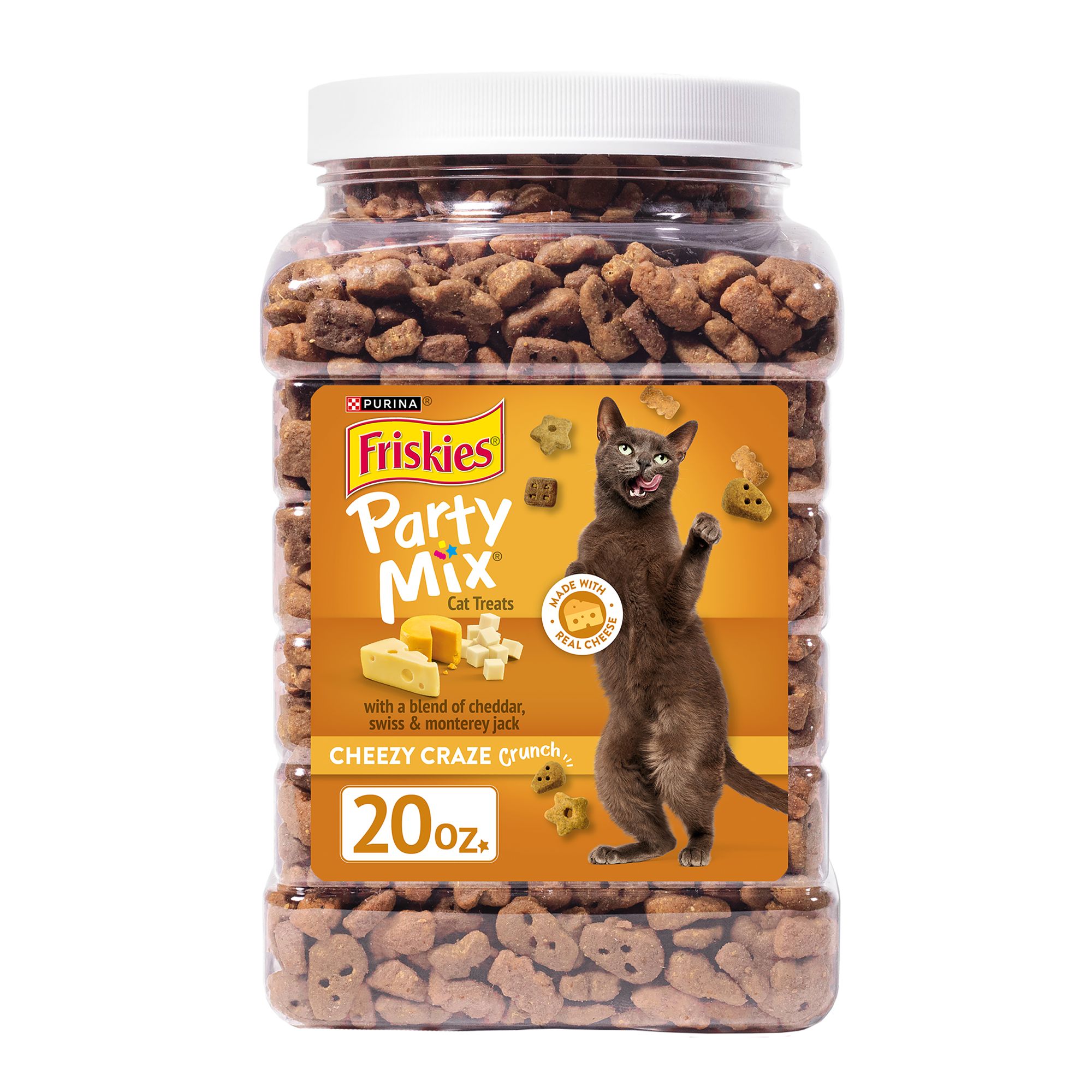
by Friskies
Overall Score: 62/100
Ingredients
- Chicken (protein)
- Chicken Meal (protein)
- Brewers Rice (carbohydrate)
- Chicken By-Product Meal (protein)
- Pea Starch (other)
- Corn Protein Meal (other)
- Barley (carbohydrate)
- Animal Fat Preserved With Mixed-Tocopherols (other)
- Liver Flavor (other)
- Natural And Artificial Flavors (other)
- Cassava Root Flour (other)
- Dried Cheddar Cheese Powder (other)
- Dried Swiss Cheese Powder (other)
- Dried Monterey Jack Cheese Powder (other)
- Phosphoric Acid (other)
- Brewers Dried Yeast (other)
- Calcium Carbonate (mineral)
- Potassium Chloride (mineral)
- Choline Chloride (vitamin)
- Salt (mineral)
- Taurine (additive)
- L-Ascorbyl-2-Polyphosphate (Vitamin C) (other)
- MINERALS [Zinc Sulfate (other)
- Ferrous Sulfate (mineral)
- Manganese Sulfate (other)
- Copper Sulfate (other)
- Calcium Iodate (mineral)
- Sodium Selenite] (other)
- VITAMINS [Vitamin E Supplement (other)
- Niacin (Vitamin B-3) (other)
- Vitamin A Supplement (vitamin)
- Calcium Pantothenate (Vitamin B-5) (other)
- Thiamine Mononitrate (Vitamin B-1) (other)
- Riboflavin Supplement (Vitamin B-2) (other)
- Vitamin B-12 Supplement (other)
- Pyridoxine Hydrochloride (Vitamin B-6) (other)
- Folic Acid (Vitamin B-9) (other)
- Vitamin D-3 Supplement (other)
- Biotin (Vitamin B-7) (other)
- Menadione Sodium Bisulfite Complex (Vitamin K)] (other)
- Yellow 5 (additive)
- Citric Acid (preservative)
- Yellow 6 (other)
- Red 40 (additive)
- Blue 2 (additive)
- Bha (A Preservative) (other)
- Bht (A Preservative) (other)
Ingredient concerns
- Chicken By-Product Meal (medium concern): While nutritionally adequate, by-product meals can vary widely in quality and digestibility. They include parts like necks, feet, and intestines, which some consumers find objectionable. Quality control is less consistent than named muscle meat sources.
- Sodium Selenite (low concern): Sodium selenite is an inorganic form of selenium with a narrower safety margin than organic forms (such as selenium yeast). It has lower bioavailability and higher potential for toxicity at elevated levels compared to organic selenium sources. Some premium pet foods use selenium yeast instead as a safer alternative.
- Menadione Sodium Bisulfite Complex (high concern): Menadione (vitamin K3) is a synthetic form of vitamin K that has been banned for use in human dietary supplements in many countries due to toxicity concerns, including potential liver damage, allergic reactions, and cytotoxicity. It can cause oxidative damage to cell membranes. Natural forms of vitamin K (K1 from plants, K2 from bacterial fermentation) are considered safer alternatives. Despite these concerns, it remains widely used in pet food as an inexpensive vitamin K source.
- Yellow 5 (high concern): Like Red 40, Yellow 5 provides no nutritional value and is added only for appearance. It has been associated with hypersensitivity reactions and behavioral effects in children in multiple studies. Banned or restricted in several countries. The EU requires warning labels on products containing tartrazine. No legitimate reason for its inclusion in pet food.
- Red 40 (high concern): Provides no nutritional benefit whatsoever and is added solely for the visual appeal to human buyers, as dogs and cats have limited color vision. Multiple studies have raised concerns about behavioral effects in children, leading the EU to require warning labels on foods containing Red 40. Some animal studies have suggested potential genotoxicity, though results are debated. The FDA maintains it is safe at approved levels, but many veterinary nutritionists recommend avoiding artificial colors entirely.
- Blue 2 (high concern): Another artificial color with zero nutritional value. Some studies have found associations with brain tumors in male rats at high doses, though these findings are not universally accepted. Like other artificial colors, it exists in pet food solely for marketing purposes and offers no benefit to the animal.
- BHA (high concern): Classified as a possible human carcinogen (Group 2B) by the International Agency for Research on Cancer (IARC). Animal studies have shown BHA can cause forestomach tumors in rodents. While the FDA still permits its use in pet food at controlled levels, many pet food manufacturers have voluntarily removed it in favor of natural preservatives like mixed tocopherols.
- BHT (high concern): Like BHA, BHT is a synthetic antioxidant with concerns about long-term safety. Some animal studies have shown tumor-promoting effects, though results are mixed -- other studies suggest potential anti-cancer properties. Banned or restricted in certain countries for food use. Many pet food manufacturers now avoid it in favor of natural alternatives.
Guaranteed analysis (dry-matter basis)
On a dry-matter basis (water removed for a fair wet-vs-dry comparison): protein 31.5%, fat 16.3%, fiber 4.3%, ash 7.5%, carbohydrate 40.3%. By calories: 28.3% from protein, 35.5% from fat, 36.2% from carbohydrate.
Dry food, with grains.
Similar products
- Purina® Friskies® Party Mix Natural Yums Adult Cat Treats - Catnip, Natural — 84/100
- Purina® Friskies® Party Mix Adult Crunchy Cat Treats - 6oz — 80/100
- Purina® Friskies® Party Mix Adult Crunchy Cat Treats - 30oz — 75/100
- Purina® Friskies® Party Mix All Life Stages Cat Treats - Beachside Crunch, With Vitamins — 66/100
- Purina® Friskies® Party Mix All Life Stages Cat Treats - Chicken Lovers Crunch, With Vitamins — 66/100
As an Amazon Associate, KibbleWatcher earns from qualifying purchases at no cost to you. Our scoring is independent of any affiliate revenue.